AI for
Peak Professional Performance
A Few of Our
Past Clients:


How We Help
Professional Services
Firms and Professionals
Align AI to Strategy
Connect AI initiatives to the strategic objectives, business drivers, and measurable results that matter most to your firm.
Diagnose & Validate
Identify high-value workflows, assess data, governance, and risk, and validate AI solutions before committing to full implementation.
Implement & Scale
Implement proven AI systems into real work and train teams with real, functional workshops, then expand what works across teams, workflows, and practice areas.
Who We Work With
CTS works with professional service firms and individuals where expertise, knowledge, professional judgment, client service, and complex workflows drive performance.
Firms
Teams/ Individuals
Consulting Partners
Consultants, advisors, associations, and professional firms that want to expand what they can offer their clients.
Use AI to improve client value, capacity, quality, responsiveness, and competitive advantage.
Build AI capability while improving the workflows that drive business results.
Combine your firm's expertise with CTS' AI consulting and tailored AI workshops to create new client solutions and new revenue streams.
How We Can Help
AI Consulting: Strategy, Implementation, Workshops, Development
Turn strategic priorities into a portfolio of actionable AI systems.
CTS works with executives, AI team leaders, and individuals to improve business performance in firms, teams, and individual professionals.
Using the CTS ADVIS AI Implementation Framework™, we help you:
- Align AI investments with strategic objectives
- Identify and diagnose high-value workflows
- Develop and validate Human + AI systems
- Establish ownership, metrics, governance, and controls
- Develop AI prompts and agents
- Guide implementation, measurement, and scale
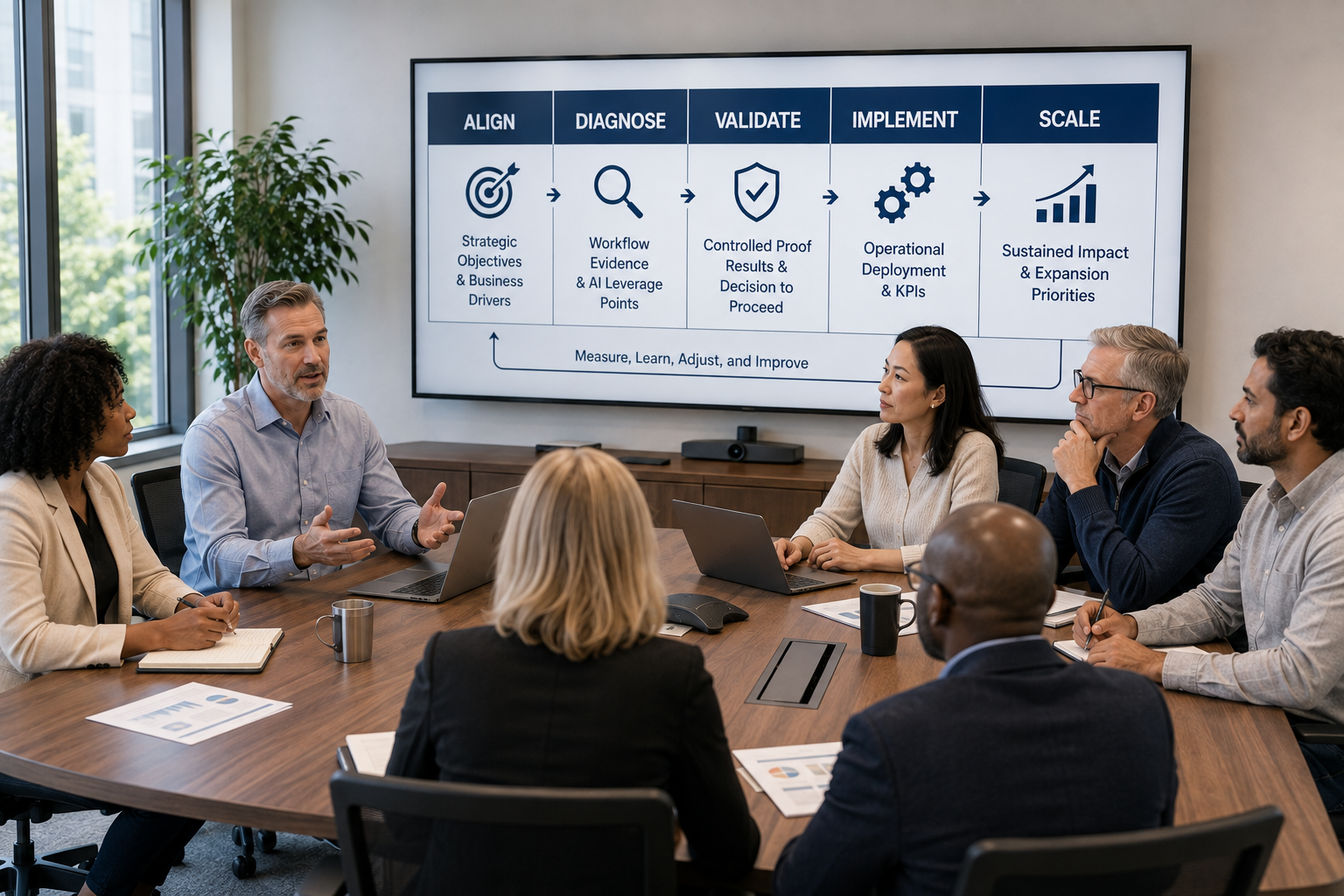
Engagements can range from cohort AI workshops that improve advanced professional skills, to department or functional team AI systems, to firm-wide alignment, implementation, and scaling of AI systems.
Know where to invest in AI, what to implement, and how to turn it into measurable performance improvement.
Tailored AI Workshops for Advanced Professional Skills
Bridge the gap between generic corporate training and measurable business performance by learning in real-work scenarios centered around your expertise.
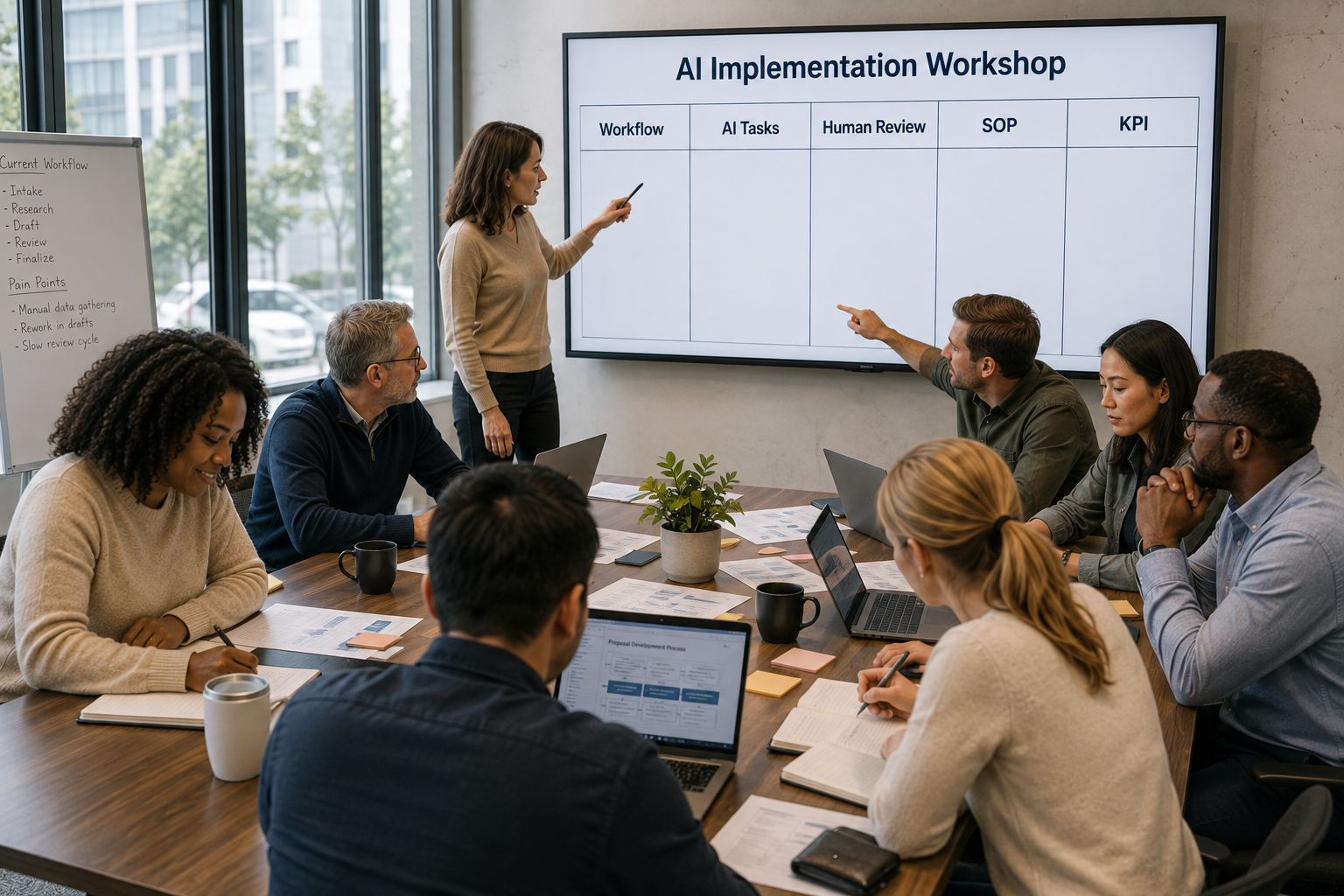
Standard AI training programs have high failure rates because they teach generic, abstract tools instead of real business operations. CTS delivers enterprise-grade in-house AI training through a highly collaborative, interactive workshop model. You won't just learn AI concepts; you will be able to immediately apply what you learn to your professional workflows.
Using hybrid workshops that follow the same teaching model used in professional courses at MIT, Stanford, and Harvard, professionals and teams will:
Learn with your workflow-specific systems.
Modify, test, and deploy customized prompts, agents, and Human + AI workflows in AI to ROI Sprints™.
Implement the CTS ADVIS AI Implementation Framework™ to learn how to manage and upgrade long-term AI infrastructure and governance.
Maximize training retention.
Multiple studies have shown that learning using real work tools and situations increases retention and capabilities at a rate 200% greater than passive, classroom-style training modules.
CTS maps training workshop objectives directly to your firm's strategic and business objectives. Whether you need targeted custom AI training or training for cross-departmental alignment, we structure our AI workshops to turn individual learning into firm-wide capability.
Your professionals and staff don't just sit through generic training. They learn how to build, implement, and manage the exact AI systems that drive your business.
The Newsletter for
Peak Professional Performance with AI:
- AI systems and tips to increase your professional performance.
- Guidance on implementing and scaling AI from the ADVIS framework.
- Best practices from hundreds of case studies.
- The Professional Performance Parable to add an insight and a smile to your day.
Critical to Success
AI for Peak Professional Performance
We will never give others access to your information.
AI Implementation Partnerships
Turn your firm's professional expertise into new AI-enabled client solutions. That means more client solutions and additional revenue streams.
Your firm already has what generic AI providers don’t have: domain expertise, proven methodologies, and trusted client relationships.
CTS can work with you in multiple ways to provide your clients with AI solutions and workshops in your expert domain - new solutions and competitive advantage.
You bring:
Client relationships + Domain expertise + Professional methodologies
CTS brings:
AI implementation + ADVIS + Workflow optimization + AI-system development + Workshops
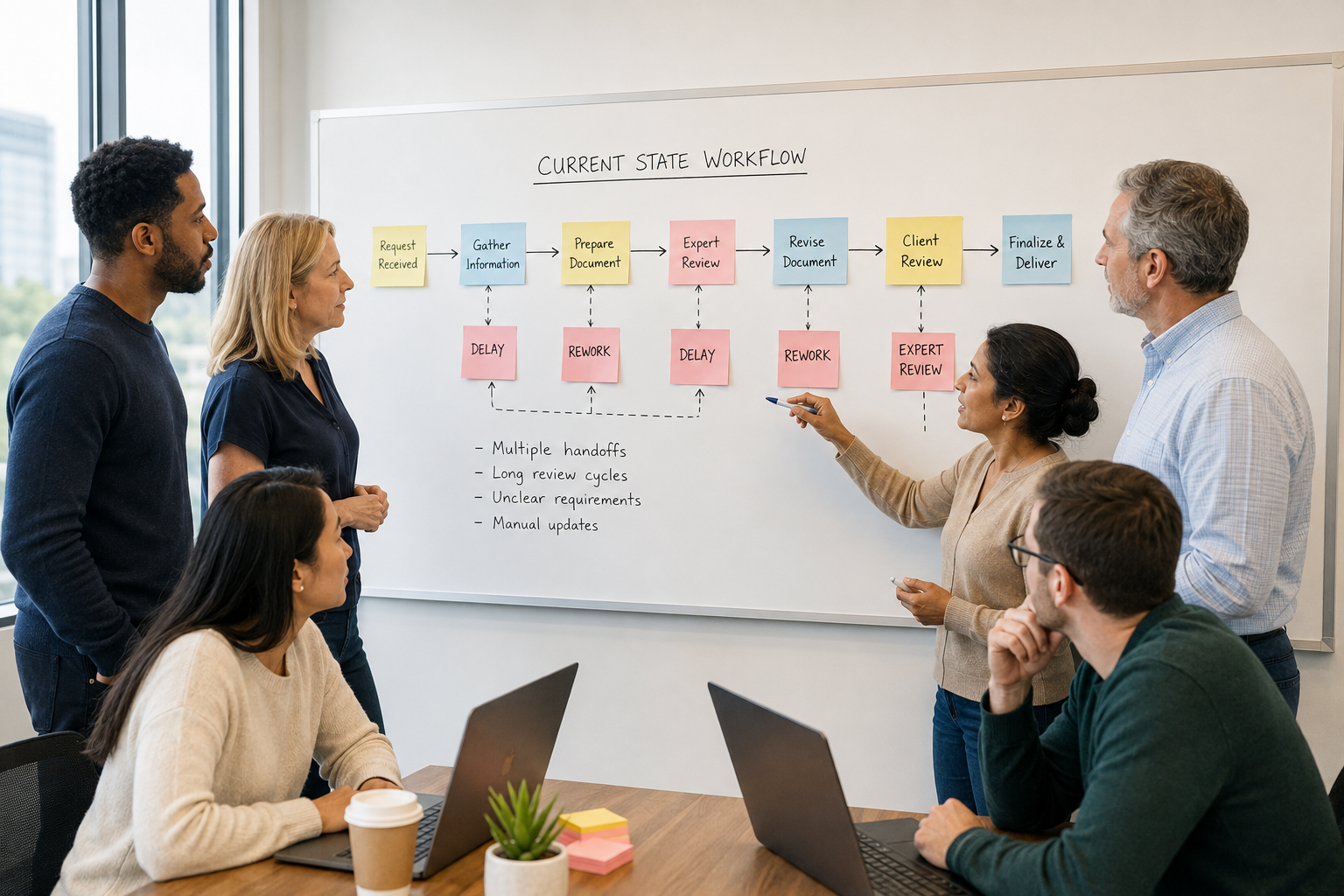
Together, we can develop and deliver AI-enabled solutions within your professional knowledge domain—without your firm needing to build an AI implementation practice from scratch.
Create greater client value. Differentiate your firm. Build new AI-enabled revenue streams.
Why the CTS Approach Works
Start with the Business - Not the Technology
Many AI initiatives begin with:
“What can we do with this AI tool?”
CTS begins with:
“What important business result do we need to improve?”
Then we work backward to the business drivers, workflows, decisions, knowledge, and professional judgment that produce that result.
The CTS approach:
- Starts with strategic and business objectives
- Diagnoses workflows before automating them
- Finds high-value AI leverage points
- Validates systems before operational deployment
- Keeps professional judgment where it matters
- Establishes ownership, governance, risks, metrics, and controls
- Measures results against baselines and targets
The goal isn’t a successful AI demonstration. It’s measurable improvement in business performance.
The CTS ADVIS
AI Implementation Frameworktm
SCALE from Strategic Opportunity to Sustained Firm Performance
CTS follows the ADVIS framework in its consulting and workshops.
ADVIS provides a structured path for identifying AI opportunities that align with objectives, testing and validating their capability, implementing them in a controlled domain, and then scaling to multiple domains. The result is increased performance.
ALIGN → DIAGNOSE → VALIDATE → IMPLEMENT → SCALE
Each stage reduces risk and tests impact before committing time and resources.
ALIGN - Strategic Justification
ALIGN AI with a strategic or Big Bet business result worth improving.
- Define the strategic objective and business drivers
- Establish ownership, baseline, metric, and target
- Develop the initial AI hypothesis
Result: Strategic Justification
DIAGNOSE - Diagnostic Evidence
Diagnose how the work is done before deciding how to apply AI.
- Map the workflow and establish current performance
- Find bottlenecks, root causes, data needs, and critical human judgment
- Identify AI leverage points and develop an AI Implementation Hypothesis
Result: Diagnostic Evidence
VALIDATE - Controlled Proof
Prove the proposed Human + AI system before the business depends on it.
- Test realistic work against predefined acceptance criteria
- Measure quality, reliability, risk, effort, and value
- Decide: Go, Revise, Retest, or Stop based on evidence
Result: Controlled Proof
IMPLEMENT - Operational Proof
Prove the validated system under real operating conditions.
- Deploy with real users doing real work
- Integrate roles, workflows, SOPs, systems, and controls
- Measure performance, quality, risk, target gap, and overall results
Result: Operational Proof
SCALE - Sustained & Expanded Performance
Expand business domains where proven AI capabilities can be implemented and managed.
- Expand into other domains, teams, workflows, and users
- Monitor and manage performance, governance, adoption, risk, and cost
- Evolve systems as business needs and AI capabilities change
Result: Sustained & Expanded Performance
Move from Individual AI Use to a
Firm-Wide Culture of Performance
AI adoption means people are using AI. Most firms get there.
AI pilots mean there are experiments or islands of productivity - most firms have built these independent islands and it results in disconnected AI pilot purgatory.
AI IMPLEMENTATION and SCALE means AI is embedded in your firm's operating model and impacting bottom-line performance.
CTS workshops are built to teach AI skills combined with how to implement an AI infrastructure. Teams learn not only how to use AI, but how to build, evaluate, manage, and continuously improve Human + AI systems.
The result is more than AI proficiency.
It is firm-wide AI capability and performance.
Why Critical to Success?
AI Implementation Grounded in
30+ Years of Performance Improvement
CTS approaches AI as a business performance discipline - not a technology.
Founder Ron Person brings 30+ years of experience spanning technology, strategy, performance improvement, digital marketing, and consulting.
His background includes:
- 17 years as one of Microsoft’s early consultants
- 14+ years consulting in strategic performance and digital marketing with Fortune 1000 and Global 1000 organizations
- 27 published business and technology books with more than one million copies sold
- Teaching at the University of California, Berkeley, Executive Extension
- MS Physics, MBA Finance/Marketing, Six Sigma Black Belt, Balanced Scorecard certified
- More than three years of intensive work with Generative AI
That experience shapes the principle behind everything CTS does:
AI Is Not the Objective. Performance Improvement Is.
Move from AI Experiments to Measurable Performance Improvement
CTS can help whether you need to align AI with your objectives, improve a critical workflow, grow your firm's profit, or create new AI-enabled services for your clients.
Where Could AI Create Measurable Strategic Value
for You and Your Clients?
Start with the business result you want to improve.
We’ll work backward from there.